
Fluent Faster Smarter
A Strategic Analysis of Language Acquisition Methods
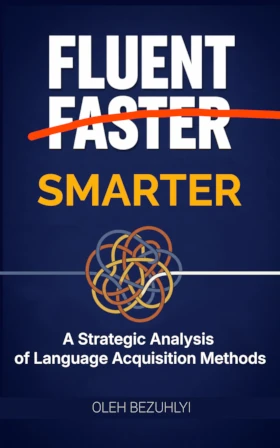
This briefing document provides a detailed synthesis of the core themes, methodologies, and strategic frameworks presented in "Fluent Faster" by Oleh Bezuhlyi. It analyzes the structural trade-offs of various language acquisition methods and provides a diagnostic approach for learners to build sustainable systems based on their specific constraints.
Executive Summary
The central thesis of the book is that language learning advice is fundamentally broken because it generalizes success without accounting for individual context. There is no "perfect" method; rather, every approach optimizes for specific skills while deliberately sacrificing others.
Critical Takeaways:
- The B2 Threshold: Functional fluency (B2) is defined as independence, where the learner stops translating and starts participating. Reaching this requires hundreds of hours of input and deliberate output.
- The Lie of "Fast Fluency": Efficiency gains are real (20–40%), but "skipping the hard part" is a myth. Success is predicted by a learner’s ability to design a system around their weakest traits.
- Method-Hopping vs. Consistency: Learners often fail by abandoning systems before they are designed to work. Consistency is defined as frequency (daily contact) rather than "heroic" short-term effort.
- The Role of AI: AI has removed the scarcity of practice but introduced a danger of passivity. It is best used as a rehearsal tool and multiplier, not a total replacement for human interaction or hard effort.
- Diagnostic Learning: Success depends on identifying non-negotiable constraints: Time Availability, Emotional Load (anxiety), Structure Tolerance, and Cognitive Style.
Part I: Traditional and Structured Methodologies
Traditional methods are often criticized for being rigid, but they offer reliability and external accountability that self-study often lacks.
1. Structured Classroom Instruction
This method utilizes a professionally designed curriculum and a trained instructor to guide a group through a controlled sequence of skills.
- Timeline to B2: 500–650 guided hours.
- Strengths: Expert feedback, balanced skill development, and built-in accountability.
- Limitations: Progress is capped by the group pace; actual speaking time per student is often very limited.
- Best For: True beginners or those who struggle with self-discipline.
2. Grammar–Translation Method (GTM)
GTM focuses on memorizing rules and translating texts between the native and target languages.
- Timeline to B2: 800–1,000 hours (literacy-heavy).
- The Reality Check: "Knowing the rules ≠ using the language." It trains the brain to think about the language rather than in it.
- Best For: Academic mastery or reading complex literary/classical texts.
- Failure Mode: Severe speaking paralysis and inability to process real-time audio.
3. The Callan Method
A high-pressure system of verbal conditioning where students must answer questions at native speed with instant correction.
- Timeline to B2: 300–450 hours (speaking-focused).
- Strengths: Ruthlessly destroys translation habits and builds fast oral reflexes.
- Limitations: Vocabulary growth is narrow, and the environment is emotionally taxing.
- Reality Check: "Fast speaking ≠ full fluency." It builds a motor skill, but comprehension and nuance may lag.
Part II: Immersion and Input-Based Methods
These methods prioritize the brain's natural ability to acquire language through exposure rather than conscious study.
1. Mass Immersion (Refold / AJATT)
Learners consume massive amounts of native media (TV, podcasts, books) for hours daily, often delaying speaking.
- Timeline to B2: 1,350–1,500 hours.
- Strengths: Exceptional listening comprehension and native-like intuition.
- Limitations: High risk of burnout and "silence" in the early stages that feels like stagnation.
- Reality Check: Immersion is not magical; it requires attention, volume, and active vocabulary consolidation via Spaced Repetition Systems (SRS).
2. The Natural Approach (Krashen-Inspired)
Focuses on "comprehensible input" (i+1) in a low-stress environment where speaking emerges voluntarily.
- Timeline to B2: 600–800 hours.
- Strengths: Reduces language anxiety and builds an intuitive "feel" for correctness.
- Failure Mode: "Low stress doesn't mean no effort." Learners may stall by staying in their comfort zone too long.
3. Content-Based Learning (LingQ)
Uses digital platforms to track known words while reading or listening to real-world content.
- Timeline to B2: 600–900 hours.
- Strengths: Respects learner intelligence by using adult-level content; quantifiable progress via word counts.
- Limitations: "Reading ≠ fluency." It builds recognition but does not inherently develop speaking reflexes.
Part III: Audio, Systematic, and App-Based Learning
1. Pimsleur (Audio-Lingual)
A strictly audio-only program using graduated interval recall.
- Timeline to B2: Not achievable alone; typically reaches A2/low B1 in 150 hours.
- Strengths: Excellent for pronunciation and building a low-friction habit during commutes.
- Limitations: Extremely limited vocabulary (~2,000 words) and no literacy training.
2. Assimil (The Two-Wave Method)
A daily textbook/audio routine involving a "passive wave" (absorption) followed by an "active wave" (production).
- Timeline to B2: 400–600 hours.
- Strengths: Gentle, sustainable, and includes cultural literacy.
- Reality Check: Finishing the book is not the finish line. It prepares the learner for the next phase but does not replace real-world interaction.
3. Adaptive Digital Apps (Duolingo, Babbel)
Gamified environments that break learning into micro-units.
- Timeline to B2: 750–1,000+ hours (requires significant supplementation).
- Strengths: High accessibility and "habit glue" for consistent daily contact.
- Limitations: "Consistency is not direction." Apps often prioritize engagement over efficiency and have a structural ceiling that prevents native-speed fluency.
Part IV: The AI Inflection Point
The emergence of Large Language Models (LLMs) has shifted the bottleneck from scarcity of practice to the discipline of the learner.
Method: LLM Assistance
Role: Multiplier
Key Advantage: Unlimited, judgment-free clarification
Major Risk: "Outsourcing" thinking to the AI
Method: Voice-First AI Tutors
Role: Speaking Simulator
Key Advantage: High repetition density; compresses hesitation
Major Risk: "Machine fluency" without social stakes
Method: Multimodal/VR/AR
Role: Contextual Rehearsal
Key Advantage: Strong spatial and situational memory
Major Risk: Novelty fatigue; hardware friction
Key AI Principle: AI is a "flight simulator." It prepares the learner for takeoff, but real "flying" only happens in unscripted human interaction.
Part V: Supporting Techniques (SRS)
Spaced Repetition Systems (SRS), such as Anki, are classified as memory engineering tools rather than primary methods.
- Function: Schedulers that bring information back right before it is forgotten.
- Critical Rule: SRS protects memory, not competence. It should never exceed the time spent on actual language input.
- Failure Mode: "Review backlog." Learners often add too many cards, leading to a system that feels like maintenance work rather than learning.
Part VI: Personalized Recommendations and Diagnostics
The book provides a framework for selecting methods based on learner archetypes and constraints.
The Five Core Constraints
- Time Availability: From 15 minutes to 2+ hours daily.
- Emotional Load: How the learner responds to stress (freeze, push, or quit).
- Structure Tolerance: Need for a syllabus vs. desire for free exploration.
- Speaking Anxiety: Level of tension regarding native interaction.
- Cognitive Style: Analytical (rules) vs. Intuitive (exposure).
Learner Archetypes and Failure Profiles
- The Busy Professional: At risk of confusing convenience with progress; needs Pimsleur or AI for short, high-impact sessions.
- The Immersion Enthusiast: At risk of passive consumption and delayed speaking; needs early controlled output checks.
- The Anxious Speaker: At risk of "avoidance disguised as preparation"; needs the Natural Approach and AI tutors to lower the barrier.
- The Speed-Focused Learner: At risk of shallow vocabulary and burnout; needs the Callan Method or intensive drills.
Recovery Plans for Stalled Learners
-
Stall:
"Understand but can't speak" → Add controlled output; reduce input.
-
Stall:
"Speak but don't understand" → Add massive listening; reduce drills.
-
Stall:
"Forget everything" → Add SRS; reduce novelty.
-
Stall:
"Burned out" → Reduce volume; maintain contact only.
Conclusion: The Path to Success
Successful learners are defined not by talent or intelligence, but by their honesty regarding constraints. They recognize that:
- Time requirements are non-negotiable.
- Plateaus are diagnostic signals, not failures.
- Systems must survive bad weeks. Consistency is the decision to return quickly after a disruption.
- B2 is a transition, not a destination. It is the moment a learner stops optimizing and starts participating in the real world.
The final directive for any learner is to stop searching for a perfect combination and start running a system—imperfectly—for at least three months. Success is the result of a system that matches reality, not inspiration.